
One Bird Strike and You're Out!
Solutions to Prevent Bird Strikes
by
Book Cover & Preview Text
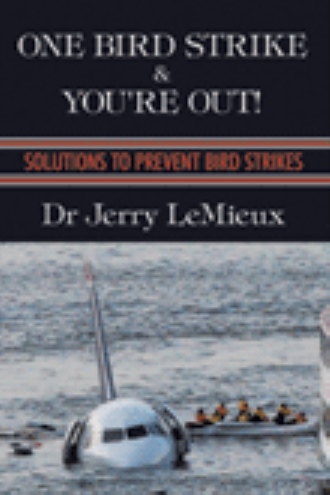
On 15 January, 2009, at 3:25 PM, US Airways Flight 1549 takes off from LaGuardia airport in New York. The aircraft makes a left turn and begins climbing to 5000 feet. The pilots are cleaning up the aircraft (i.e., bringing the gear and flaps up), accelerating to 250 knots, and executing the after-takeoff checklist. Two minutes later, at 3:27:09 PM, 219 knots, 2700 ft, the aircraft collides with a large flock of Canada geese.
3:29:25 PM, 192 knots, 726 feet – By this time, the pilot must have seen how far away the runway actually was. Using his expert judgment, he decides that he does not have enough altitude and airspeed to glide into Teterboro airport.
LaGuardia Controller: “Okay, which runway would you like at Teterboro.”
Pilot: “We’re gonna be in the Hudson.”
3:29:29 PM, 192 knots, 657 feet – Here, he makes the final decision to ditch in the Hudson River.
LaGuardia Controller: “I’m sorry. Say again, cactus.”
3:29:35, 190 knots, 534 feet – The controller can’t believe what he is hearing, so he asks the pilot to repeat what he said. The controller must have also realized that he might be the last person to talk to anyone on the crew.
LaGuardia Controller: “Cactus, ah, cactus fifteen forty-nine, radar contact is lost. You also got Newark airport off your two o’clock and about seven miles.”
3:29:46, 189 knots, 312 feet – Here, the controller is trying to maintain communication; he just lost contact with the aircraft as it dropped under his radar coverage. The co-pilot says “No relight,” and the Captain says, “Ok, let’s go. Put the flaps out.” The flaps generate more lift for the aircraft at a slow airspeed.
LaGuardia Controller: “Cactus fifteen twenty-nine, uh, you still on?”
3:30:16 PM, 139 knots, 360 feet – Passengers are placing their heads in their laps.
LaGuardia Controller: “Cactus fifteen forty-nine, you got runway two nine at Newark at your two o’clock and seven miles.
3:30:30 PM, 131 knots, 225 feet – The Captain says “Got any ideas?” and the co-pilot responds “Actually not.” Aircrews are trained to work as a team, and the Captain is asking the co-pilot if there is anything they may have missed.
3:30:43 PM, 128 knots, 0 feet – After a hard jolt, the aircraft comes to a stop next to the Intrepid Aircraft Sea, Air and Space Museum. A total of 3 minutes and 34 seconds had elapsed between the time of the bird strike and landing in the Hudson. Later, the flight attendant in the forward cabin will describe the touchdown as firm, and the aft flight attendant will describe it as violent. Initially, the flight attendants do not realize they are in the water. No one in the cabin has been hurt, and the passengers remain calm. The fight attendants yell “evacuate” and passengers move toward the doors and get on the rafts. The evacuation proceeds very smoothly, and it’s not long until the passengers are picked up by boats. Many passengers are standing on the wing. By 4:20 PM, all passengers and crewmembers are off the airplane. The aircraft is then tied to tugboats, pushed to Battery Park and tied to a pier.
As you’ll learn in the chapters ahead, when an aircraft collides with a flock of large birds, a successful outcome only becomes possible if pilot skill combines with a certain element of luck. But what if the ceiling had been down to 200 feet, for example? There would have been virtually no time to decide on where to land, and the pilot would have had to just accept where he was. The result would most likely have been an impact into a densely populated area with total loss of passengers and crew and probable loss of life on the ground as well. The government would have reacted more aggressively in the aftermath, as they did back in ’80s when airliner-to-airliner mid-air collisions had become so frequent that there arose a public outcry.
The first fatality caused by the collision between an aircraft and a bird occurred in 1912 on a transcontinental flight when a gull jammed in the aircraft control cables of a Wright Flyer, causing loss of control and a crash. Since the time of that accident, many more aircraft have taken to the skies. And since 1912, bird populations have increased dramatically too. In the next 10 years, annual air passenger traffic is expected to increase from the current value of 600 million to 1 billion, and over the next 25 years, the projections for increased air travel stand at 40%.
Aircraft bird strikes occur almost every single day. Many cause damage but no loss of life. It may seem strange to say, due to the enormity of the losses that bird strikes have caused, but we have been lucky so far. We have to stop picking away at this problem with temporary, limited solutions that only delay the inevitable. I’ve been on technical teams with government and industry, and we have solved some of the most difficult problems involved in the defense of our country, so I know the power of effective collaboration, and I know how achievable these seemingly impossible solutions actually are. I have served with some of the smartest people and the greatest leaders, and I have observed that, ultimately, the greatest problems are solved people feel inspired to act selflessly and tackle each little challenge that arises. When airliners were colliding with other aircraft in the 80s, and when airliners were colliding with the ground, we analyzed the factors involved, isolated the cause, and developed a solution that we then perfected over time. These were very difficult issues, and our final solution was permanent and well thought-out.
I strongly believe that bird targets need to be sent directly to the cockpit; and fortunately, today, we have the technological capability to do so, although the necessary components have not been assembled into the ideal combination – yet.
Formats


Book Details
About the Book
Dr. Jerry LeMieux has over thirty-five years and 10,000 hours of aviation experience. He has flown military fighter aircraft and is a major airline pilot. He was responsible for solving national aviation issues as an Executive Safety Chairman for the Airline Pilots Association (ALPA). He is currently developing both ground- and airborne-based radar collision avoidance systems for Unmanned Air Systems.
He has been on the staff and faculty at MIT, Boston University, Daniel Webster College, and Embry Riddle Aeronautical University where he taught courses in electrical and aeronautical engineering and advanced mathematics. He has published technical papers on radar design and has been a Chairman and Technical Paper Selection Committee Member for the National and International Radar Conferences, a Senior Member of the Institute of Electrical and Electronics Engineers, in addition to being a member of several professional organizations.
While piloting a fighter aircraft, he has personally experienced an aircraft bird strike that resulted in significant loss of thrust in a jet engine. He recently filed a patent for a ground-based radar system that sends bird targets to the cockpit to prevent aircraft bird strikes. The technology is available today to permanently solve this worldwide problem.
About the Author
Dr. Jerry LeMieux has thirty-five years and 10,000 hours of aviation experience. He has flown military fighter aircraft and is a major airline pilot. He holds BS, MS, and PhD degrees in electrical engineering and has twenty-two years of experience with design, development, integration, and testing of radar systems.