
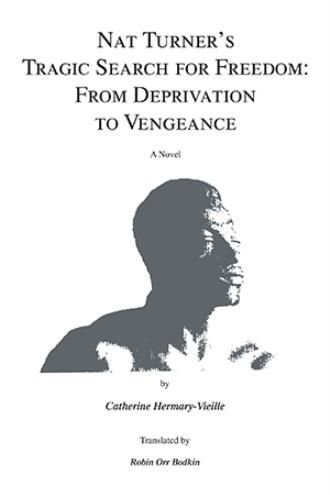
Nat Turner's Tragic Search for Freedom
From Deprivation to Vengeance
by
Book Cover & Preview Text
Formats

Book Details
About the Book
In early November 1831 a slave by the name of Nat Turner was tried, convicted, and executed for murder in the Commonwealth of Virginia. Approximately sixty white men, women, and children died as a result of the rebellion that he planned and led against the slaveholders of Jerusalem, a small farming hamlet in the southeast section of the state. Of the hundreds of uprisings that took place throughout the history of American slavery Nat Turner's rebellion was more successful than most in dispelling the myth of the "contented slave," an individual too passive to fight for basic human rights or self-determination.
Nat Turner's Tragic Search for Freedom is a narrative of the events that led up to this rebellion as well as drove it to its bloody conclusion. If it were but a question of its known facts, which are few and far between, one might feel content with a quick determination of its import. After behavior beyond the pale, a protagonist, whether as an actual historical figure or as a fictionalized representation, receives his just due. That is, in the eyes of the law a slave rebels against his "masters" by taking their lives or encouraging others to do so. Subsequently, he is arrested, tried, and sentenced to a fate as equally horrifying as the one visited upon his victims. Catherine Hermary-Vieille, however, perceptively anchors the origin of this story elsewhere. From beginning to end she paints it with Africa in mind as well as the inescapable influence that a mother and her beliefs can bring to bear on her child. "As long as blood coursed through her [Nat's mother] veins, no one would ever convince her that a black person's desire to be free was wrong or unlawful. What she did know for sure, however, was the indisputable criminality of forcing another human being into the bonds of slavery. She could never break those bonds by herself, but Nat... would find a way to do it." Thus, Hermary-Vieille invites the reader to focus not so much on the Nat Turner dossier as on the larger meaning of his life and its message. In this light his story is both a literal and figurative search for freedom, a search that tragically consumes his life as it feeds his spirit.
About the Author
As Colette R. Oberlin of France-Amérique noted in 1998 after L'Ange noir (translated as Nat Turner's Tragic Search for Freedom) had received the Prix Littéraire du Quartier Latin, "we don't have to introduce Catherine Hermary-Vieille anymore. With all her success... her talent is unanimously recognized."
It is indeed! With more than two decades of stirring prose behind her, some eighteen books to her credit, many already in translation, copies sold by the hundreds of thousands, sufficient critical attention and literary awards to arouse the interest of even the most successful writer, Catherine Hermary-Vieille is at the top of her game. Yet, far be it from her to rest on her laurels. While the notion of a fine wine over time comes to mind, it seems woefully inadequate as a characterization of this remarkably gifted, creative writer whose perspicacity and attention to detail have been the hallmark of a distinguished career.
Right from the beginning with Le Grand Vizir de la Nuit (which captured the Prix Fémina in 1981) her writing assumed that most hallowed of French traditions-- le mot juste-- and did so in a rather unpretentious way. Whether they know her as a biographer (in La Marquise des Ombres, the saga of a famous murderess or the tragic destinies of Romy and Lola), a journalist (her numerous articles in such notable publications as Le Figaro, Paris Match, or Gala), a reporter (especially her insightful communiqués from Lebanon for Jours de France), or an editor (her deft contributions to the film productions of Gilles Carle and Alain Jessuah), her readers have steadily grown in number through the years. They have come to appreciate that distinctive clarity and penetrating insight that her writing brings to whatever subject captures her gaze.